Optical Character Recognition Market Size & Share Analysis - Growth Trends And Forecast (2026 - 2031)

The Optical Character Recognition Market is Segmented by Type (Software [Mobile OCR Software, and More], Services [Professional Services, and More]), Deployment Mode (On-Premise, and Cloud), Technology (Conventional OCR, and More), Application (Invoice and Bill Processing, and More), End-User Industry (BFSI, Retail and E-Commerce, and More), and Geography. The Market Forecasts are Provided in Terms of Value (USD).

Optical Character Recognition Market Size and Share

Market Overview

Study Period 2020 - 2031
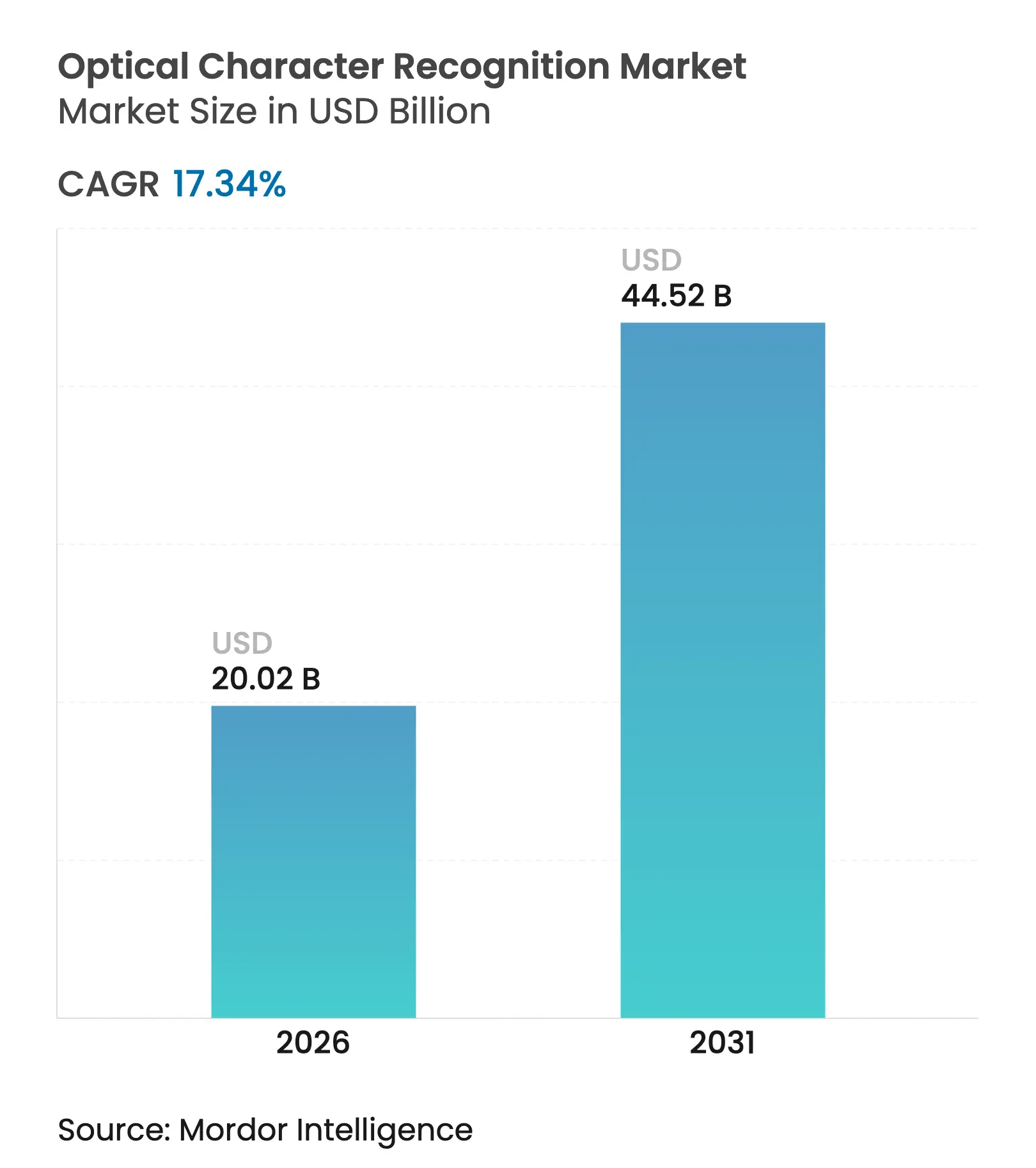
Market Size (2026)USD 20.02 Billion
Market Size (2031)USD 44.52 Billion
Growth Rate (2026 - 2031)17.34 % CAGR
Fastest Growing MarketAsia Pacific
Largest MarketNorth America
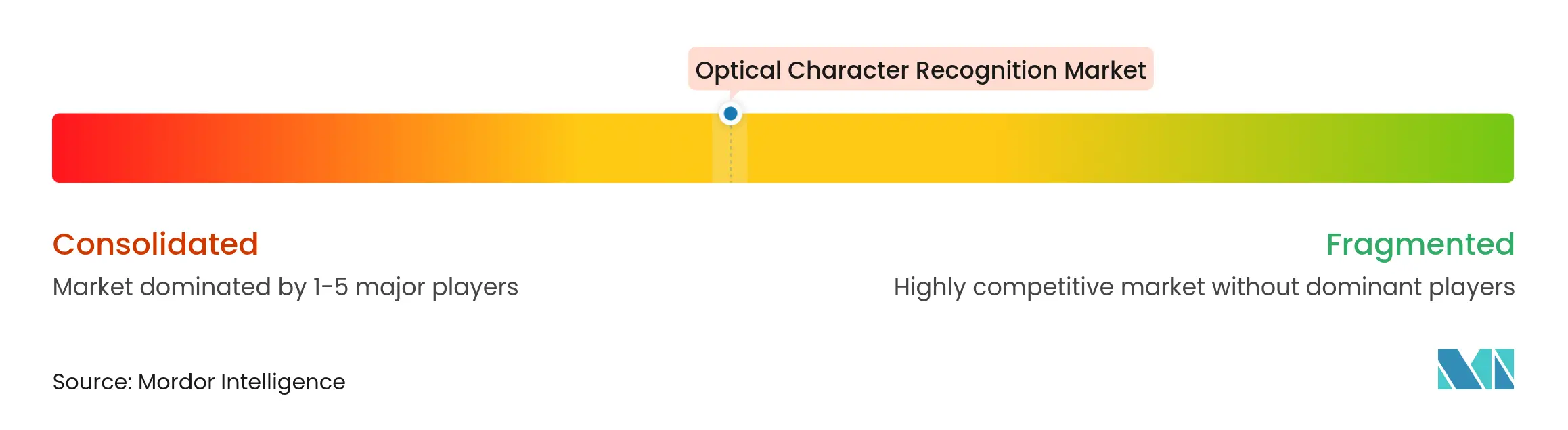
Market ConcentrationMedium

Major Players

Major players in Optical Character Recognition industry

*Disclaimer: Major Players sorted in no particular order.

Optical Character Recognition Market (2025 - 2030)
Mordor Intelligence Logo

Optical Character Recognition Market Analysis by Mordor Intelligence

The optical character recognition market is expected to grow from USD 17.06 billion in 2025 to USD 20.02 billion in 2026 and is forecast to reach USD 44.52 billion by 2031 at 17.34% CAGR over 2026-2031. Growth is propelled by AI-driven accuracy gains, expanding cloud deployment, and tighter regulatory mandates that encourage automated compliance checks. Technology vendors are shifting from standalone OCR engines to full-stack document-intelligence platforms that combine recognition, classification, and validation in a single workflow. Multimodal large language models, which read both images and text, are lowering per-page processing costs and widening adoption across small and midsize enterprises. Intensifying competition is pushing suppliers to differentiate through domain-specific templates, language support, and value-added analytics rather than pure extraction speed.

Key Report Takeaways

  • By component, Software led with 77.30% revenue share in 2025, while Services is projected to expand at a 17.36% CAGR through 2031.
  • By deployment Mode, Cloud accounted for 65.20% of the optical character recognition market share in 2025; On-Premise solutions are growing fastest at 15.45% CAGR to 2031.
  • By technology, Conventional OCR retained 70.40% share in 2025; Intelligent Character Recognition is advancing at a 18.95% CAGR over the outlook period.
  • By application, Invoice and Bill Processing held 32.40% of the optical character recognition market size in 2025, whereas Identity Verification and KYC is forecast to grow at 17.85% CAGR.
  • By end-use industry, BFSI commanded 25.60% share of the optical character recognition market size in 2025, but Healthcare is set to post the highest CAGR at 19.45%.
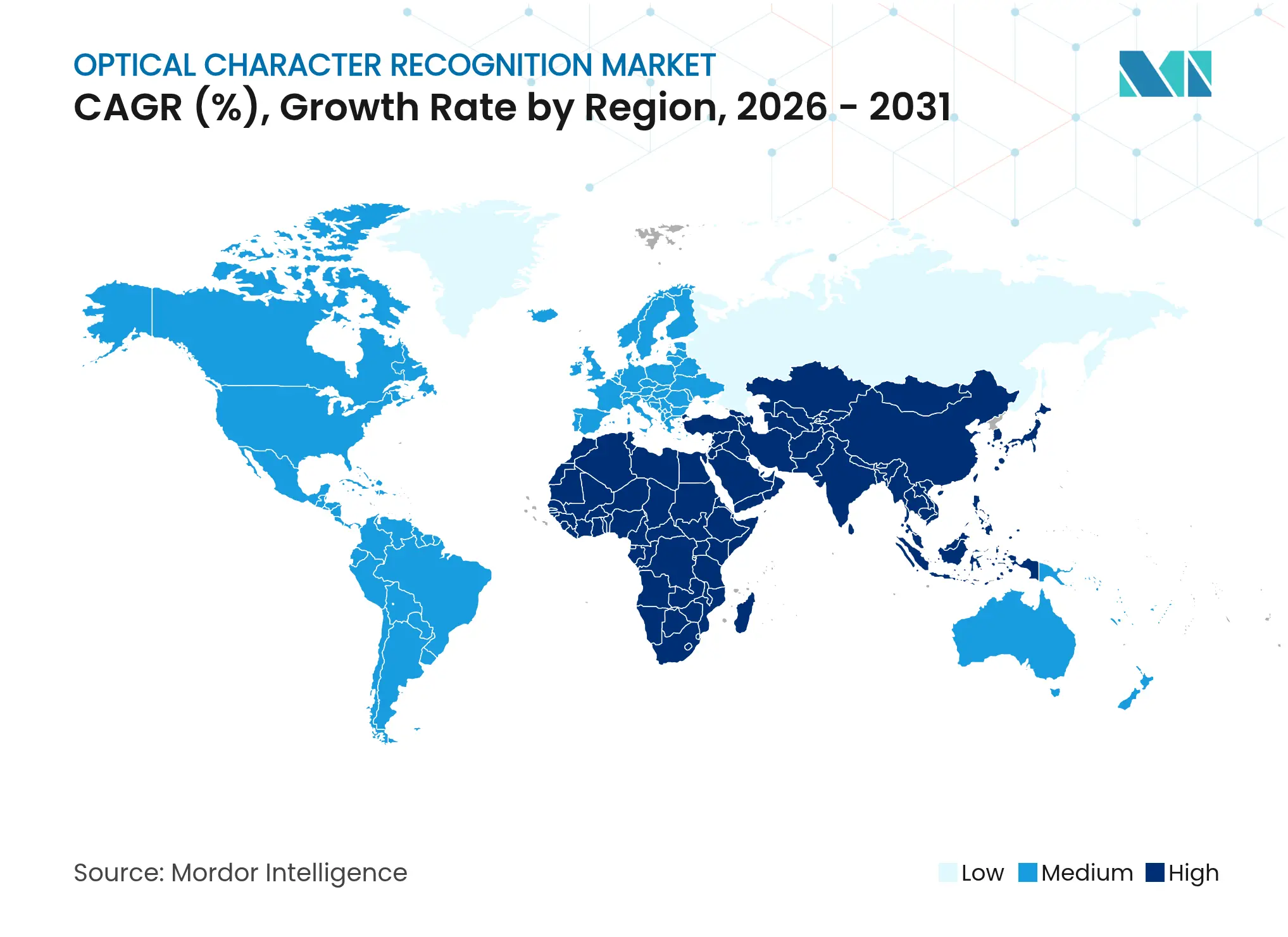
  • By geography, North America led with 39.50% revenue share in 2025, yet Asia-Pacific is projected to rise at 17.58% CAGR to 2031.

Segment Analysis

By Component: Services Growth Outpaces Software Dominance

The software segment held a 77.30% revenue stake in 2025, establishing a solid base for the optical character recognition market. Services, however, are projected to deliver a 17.36% CAGR through 2031 as organizations demand consulting, customization, and managed operations to realize full ROI. This pivot shows that expertise, not merely code, now unlocks the value of OCR deployments.

Professional-services providers build vertical playbooks that embed industry terminology and regulatory templates into OCR pipelines. Healthcare integrators, for instance, supply medical lexicons to raise extraction precision, whereas banking specialists focus on AML and KYC documents. Managed services relieve internal IT teams from tuning recognition models, ensuring the systems stay current with new document formats.
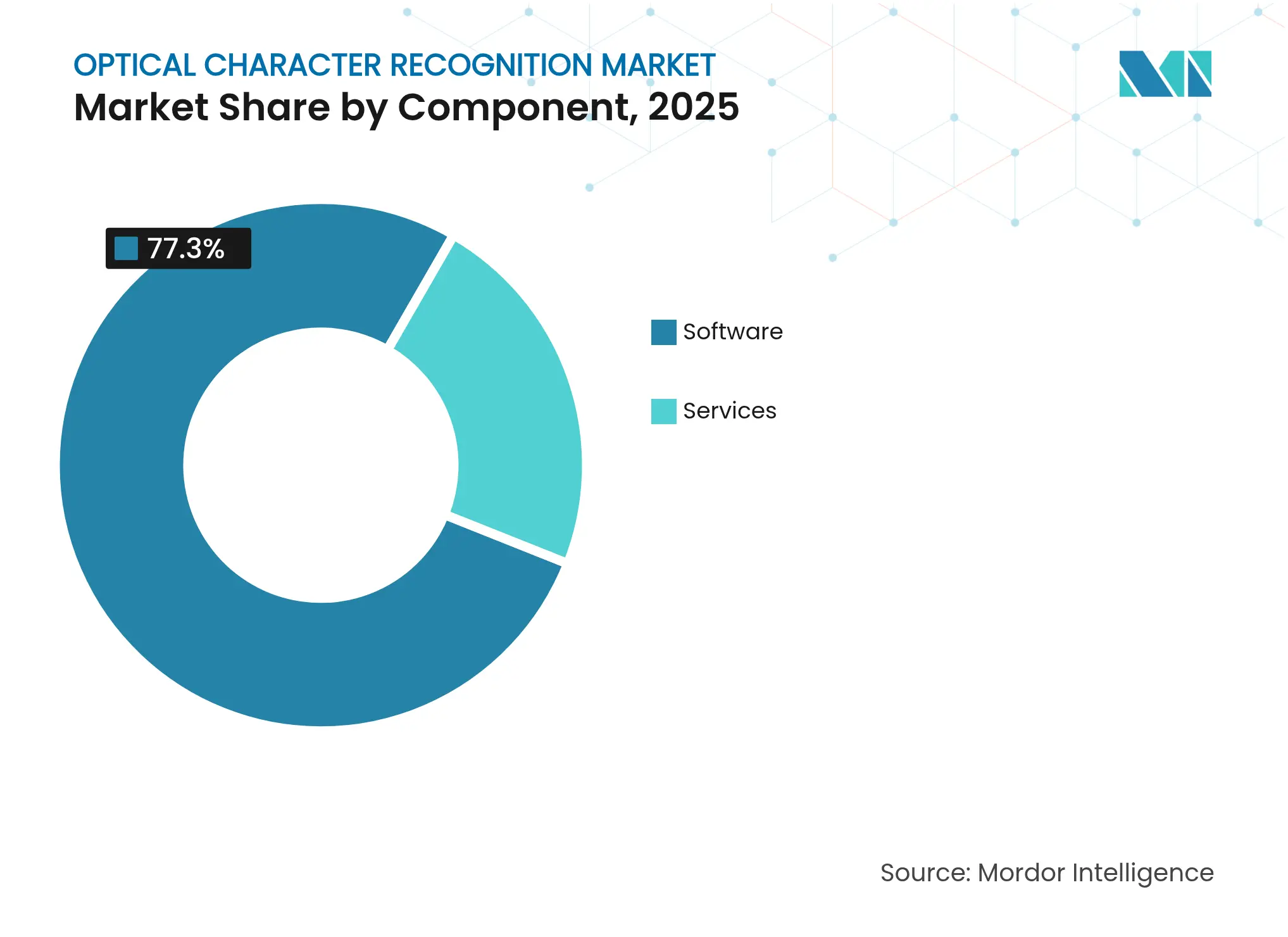
Optical Character Recognition Market: Market Share by Component, 2025

Note: Segment shares of all individual segments available upon report purchase

By Deployment Mode: Cloud Leads While On-Premise Gains Strategic Importance

Cloud deployments generated 65.20% of 2025 revenue, reflecting customer preference for elastic scaling and automatic algorithm improvements. Even so, on-premise solutions are set to rise at 15.45% CAGR as regulated sectors require data residency. Financial institutions often keep cheque imaging on local servers while shifting less sensitive workflows to the cloud.

Hybrid architectures dominate. Microsoft ships its OCR containers to customer data centers, letting firms process documents locally and still connect to Azure AI for advanced post-processing. This configuration positions the optical character recognition market as both a SaaS and an appliance play, depending on compliance thresholds.

By Technology: Intelligent Character Recognition Disrupts Traditional OCR

Conventional OCR retained 70.40% of 2025 revenue, yet Intelligent Character Recognition is forecast to advance 18.95% CAGR because it deciphers cursive scripts and semi-structured forms. Deep-learning ICR engines now hit 85% accuracy on clear handwriting, expanding the addressable workload beyond typed invoices.

Optical mark and intelligent word recognition modules complement ICR, processing check-boxes and short free-text notes. Multimodal AI models, capable of reading entire document layouts, further erode the distinction between OCR and natural language processing, creating a convergence zone that redefines the optical character recognition market.

Awards & Accreditations - Mordor Intelligence

Recognized by Experts. Trusted by Leaders.

A trusted intelligence partner to global decision-makers across 90+ countries.

Mordor Intelligence Great Place to Work Award 2023-2024Mordor Intelligence Great Place to Work Award 2024-2025Mordor Intelligence Great Place to Work Award 2025-2026
Mordor Intelligence Recognized by MRSIMordor Intelligence ISO Certified 2015Mordor Intelligence ISO Certified 2022Mordor Intelligence ESOMAR Certified

By Application: Identity Verification Emerges as Growth Leader

Invoice and bill processing kept 32.40% share in 2025, anchoring core demand, while Identity Verification and KYC is projected to scale at 17.85% CAGR. Banks and fintechs integrate OCR with facial recognition to authenticate documents during mobile onboarding, cutting customer acquisition times from days to minutes.

Document management, although mature, remains essential as firms digitize archives for searchability. Packaging and label recognition leverages OCR for traceability across manufacturing lines, while healthcare providers combine OCR with clinical NLP to code unstructured notes. These specialized cases expand the optical character recognition market beyond accounts-payable hubs.
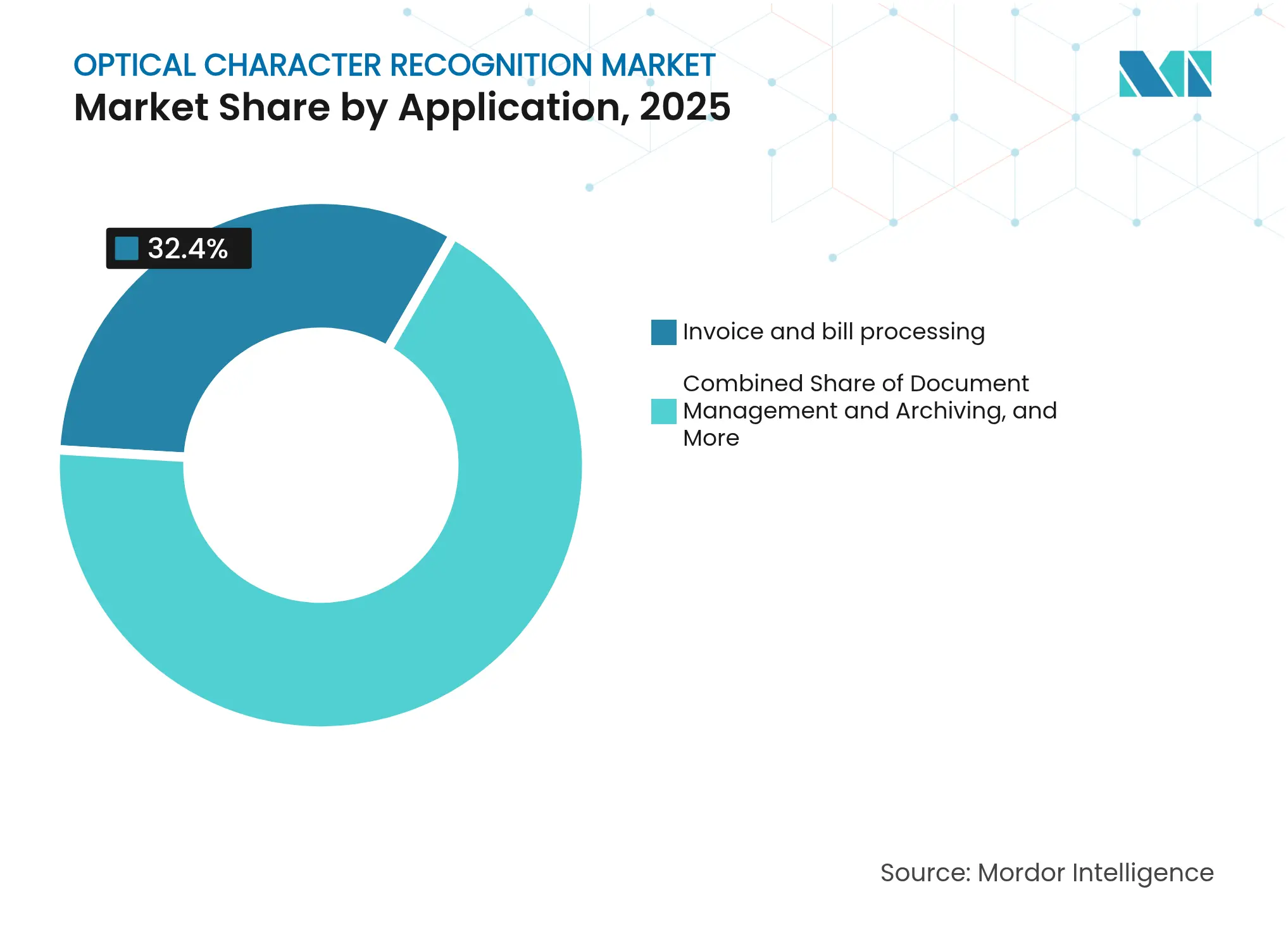
Optical Character Recognition Market: Market Share by Application, 2025

Note: Segment shares of all individual segments available upon report purchase

By End-Use Industry: Healthcare Digitization Drives Fastest Growth

BFSI controlled 25.60% revenue in 2025 through loan files, statements, and compliance records. Healthcare is poised for a 19.45% CAGR, fueled by electronic health-record mandates and the need to automate claims. OCR engines trained on clinical vocabularies extract diagnosis codes directly from scanned charts, improving billing accuracy.

Retail and e-commerce businesses employ OCR for product-label capture and customer ID checks at pickup points. Government agencies digitize land records and passports to modernize citizen services. Manufacturing plants embed OCR in quality-control stations, ensuring regulatory labels match batch data.

Geography Analysis

North America commanded 39.50% of optical character recognition market revenue in 2025, underpinned by high labor costs that justify automation and by a dense cluster of technology suppliers. HIPAA and KYC regulations accelerate adoption in healthcare and banking. Vendors in the region integrate OCR with robotic-process-automation bots, generating compound efficiency gains.

Asia-Pacific is the fastest-growing territory at 17.58% CAGR. China’s cloud providers, such as Alibaba Cloud and Tencent Cloud, bundle recognition services with broader AI suites, lowering entry barriers for local firms. India’s digitization programs and high-volume banking sector create fertile ground for KYC OCR, while Japan and South Korea focus on manufacturing quality control.

Europe shows strong uptake across public and private sectors but remains cautious on data sovereignty. Germany and France favor on-premise or sovereign-cloud installations to meet GDPR. Supply-chain resiliency goals push logistics firms toward automated document capture for end-to-end visibility, sustaining steady growth in the region.
Optical Character Recognition Market

Competitive Landscape

Market Concentration

Optical Character Recognition Market Concentration

The optical character recognition market features a mix of diversified software giants and niche AI entrants. Adobe, Google, and Microsoft embed OCR into broader productivity suites, offering wide reach. ABBYY, Kofax, and UiPath differentiate through vertical templates and workflow orchestration. Startups such as Mistral AI use large language models to reach 99% accuracy at USD 1 per 1,000 pages, raising the competitive bar [3]Campus Technology, “Mistral AI Introduces AI-Powered OCR,” campustechnology.com.

Strategic moves include API launches for developer ecosystems, acquisitions that add regulatory expertise, and containerized deployments for edge processing. Descartes Systems Group’s purchase of OCR Services expands trade-compliance coverage, while ABBYY’s new API targets low-code integration. White-space remains in low-resource language support and blockchain-verified document authenticity.

As vendors converge on similar deep-learning techniques, differentiation shifts to pre-built domain knowledge, governance features, and total cost of ownership. Partnerships with hyperscale clouds and RPA platforms extend market reach, keeping competition active yet preventing monopolistic dominance.

Optical Character Recognition Industry Leaders

Dots and Lines - Pattern
1 ABBYY Software Ltd.
2 Google LLC
3 IBM Corporation
4 Microsoft Corporation
5 Adobe Inc.

*Disclaimer: Major Players sorted in no particular order

Mordor Intelligence Logo

Recent Industry Developments

  • April 2025: ABBYY launched an OCR API that boosts accuracy in intelligent-automation workflows, reinforcing its Everest Group leadership position.
  • April 2025: OCR Studio released a WebAssembly-based engine for browser-based ID verification covering 220 jurisdictions.
  • March 2025: Mistral AI introduced an OCR API processing 2,000 pages per minute at 97-99.54% accuracy across 11 languages
  • March 2024: Descartes Systems Group acquired OCR Services for USD 90 million, expanding its global trade-compliance suite.

Table of Contents for Optical Character Recognition Industry Report

1. INTRODUCTION

  • 1.1Market Definition and Study Assumptions
  • 1.2Scope of the Study

2. RESEARCH METHODOLOGY

3. EXECUTIVE SUMMARY

4. MARKET LANDSCAPE

  • 4.1Market Overview
  • 4.2Market Drivers
    • 4.2.1Rising automation in industries
    • 4.2.2Adoption of cloud technology
    • 4.2.3Integration with IDP platforms
    • 4.2.4AI-powered OCR for healthcare claims
    • 4.2.5Accessibility-compliance regulations
    • 4.2.6Low-code OCR SDK uptake by SMBs
  • 4.3Market Restraints
    • 4.3.1High initial investment costs
    • 4.3.2Data-privacy concerns in cloud OCR
    • 4.3.3Low-resource language handwriting limits
    • 4.3.4GPU supply constraints for DL OCR
  • 4.4Value / Supply-Chain Analysis
  • 4.5Evaluation of Critical Regulatory Framework
  • 4.6Impact Assessment of Key Stakeholders
  • 4.7Technological Outlook
  • 4.8Porter's Five Forces Analysis
    • 4.8.1Bargaining Power of Suppliers
    • 4.8.2Bargaining Power of Consumers
    • 4.8.3Threat of New Entrants
    • 4.8.4Threat of Substitutes
    • 4.8.5Intensity of Competitive Rivalry
  • 4.9Impact of Macro-economic Factors

5. MARKET SIZE AND GROWTH FORECASTS (VALUE)

  • 5.1By Component
    • 5.1.1Software
    • 5.1.1.1Mobile OCR Software
    • 5.1.1.2Desktop OCR Software
    • 5.1.1.3Cloud OCR Software
    • 5.1.2Services
    • 5.1.2.1Professional Services
    • 5.1.2.2Managed Services
  • 5.2By Deployment Mode
    • 5.2.1On-Premise
    • 5.2.2Cloud
  • 5.3By Technology
    • 5.3.1Conventional OCR
    • 5.3.2Intelligent Character Recognition (ICR)
    • 5.3.3Optical Mark Recognition (OMR)
    • 5.3.4Intelligent Word Recognition (IWR)
    • 5.3.5Others
  • 5.4By Application
    • 5.4.1Invoice and Bill Processing
    • 5.4.2Identity Verification and KYC
    • 5.4.3Document Management and Archiving
    • 5.4.4Banking Cheque Processing
    • 5.4.5Packaging and Label Recognition
    • 5.4.6Others
  • 5.5By End-Use Industry
    • 5.5.1BFSI
    • 5.5.2Retail and E-commerce
    • 5.5.3Government
    • 5.5.4Healthcare
    • 5.5.5Education
    • 5.5.6Transportation and Logistics
    • 5.5.7Manufacturing
    • 5.5.8Others
  • 5.6By Geography
    • 5.6.1North America
    • 5.6.1.1United States
    • 5.6.1.2Canada
    • 5.6.1.3Mexico
    • 5.6.2South America
    • 5.6.2.1Brazil
    • 5.6.2.2Argentina
    • 5.6.2.3Rest of South America
    • 5.6.3Europe
    • 5.6.3.1Germany
    • 5.6.3.2United Kingdom
    • 5.6.3.3France
    • 5.6.3.4Italy
    • 5.6.3.5Spain
    • 5.6.3.6Russia
    • 5.6.3.7Rest of Europe
    • 5.6.4Asia-Pacific
    • 5.6.4.1China
    • 5.6.4.2Japan
    • 5.6.4.3India
    • 5.6.4.4South Korea
    • 5.6.4.5Australia and New Zealand
    • 5.6.4.6Rest of Asia-Pacific
    • 5.6.5Middle East and Africa
    • 5.6.5.1Middle East
    • 5.6.5.1.1Saudi Arabia
    • 5.6.5.1.2United Arab Emirates
    • 5.6.5.1.3Turkey
    • 5.6.5.1.4Rest of Middle East
    • 5.6.5.2Africa
    • 5.6.5.2.1South Africa
    • 5.6.5.2.2Nigeria
    • 5.6.5.2.3Egypt
    • 5.6.5.2.4Rest of Africa

6. COMPETITIVE LANDSCAPE

  • 6.1Market Concentration
  • 6.2Strategic Moves
  • 6.3Market Share Analysis
  • 6.4Company Profiles (includes Global level Overview, Market level overview, Core Segments, Financials as available, Strategic Information, Market Rank/Share for key companies, Products and Services, and Recent Developments)
    • 6.4.1ABBYY Software Ltd.
    • 6.4.2Adobe Inc.
    • 6.4.3Google LLC
    • 6.4.4Microsoft Corporation
    • 6.4.5IBM Corporation
    • 6.4.6Anyline GmbH
    • 6.4.7Kofax Inc.
    • 6.4.8NTT DATA Corporation
    • 6.4.9LEAD Technologies, Inc.
    • 6.4.10Accusoft Corporation
    • 6.4.11Creaceed SPRL
    • 6.4.12Black Ice Software LLC
    • 6.4.13Beijing Wintone Science and Technology Co., Ltd.
    • 6.4.14Amazon Web Services, Inc.
    • 6.4.15Baidu, Inc.
    • 6.4.16Rossum Ltd.
    • 6.4.17UiPath Inc.
    • 6.4.18Parascript LLC
    • 6.4.19OpenText Corporation
    • 6.4.20Hyland Software, Inc.

7. MARKET OPPORTUNITIES AND FUTURE TRENDS

  • 7.1White-space and Unmet-need Assessment

Research Methodology Framework and Report Scope

Market Definitions and Key Coverage

Our study defines the optical character recognition (OCR) market as all licensed software, embedded engines, and bundled services that transform scanned or photographed text into machine-encoded data across desktop, mobile, and cloud environments. The model counts revenue generated from initial licenses, subscription fees, and recognized implementation or managed support linked directly to OCR functionality.
Scope Exclusion: Pure handwriting-only transcription services and single-purpose barcode readers are outside this assessment.

Segmentation Overview

  • By Component
    • Software
      • Mobile OCR Software
        • Desktop OCR Software
          • Cloud OCR Software
          • Services
            • Professional Services
              • Managed Services
            • By Deployment Mode
              • On-Premise
                • Cloud
                • By Technology
                  • Conventional OCR
                    • Intelligent Character Recognition (ICR)
                      • Optical Mark Recognition (OMR)
                        • Intelligent Word Recognition (IWR)
                          • Others
                          • By Application
                            • Invoice and Bill Processing
                              • Identity Verification and KYC
                                • Document Management and Archiving
                                  • Banking Cheque Processing
                                    • Packaging and Label Recognition
                                      • Others
                                      • By End-Use Industry
                                        • BFSI
                                          • Retail and E-commerce
                                            • Government
                                              • Healthcare
                                                • Education
                                                  • Transportation and Logistics
                                                    • Manufacturing
                                                      • Others
                                                      • By Geography
                                                        • North America
                                                          • United States
                                                            • Canada
                                                              • Mexico
                                                              • South America
                                                                • Brazil
                                                                  • Argentina
                                                                    • Rest of South America
                                                                    • Europe
                                                                      • Germany
                                                                        • United Kingdom
                                                                          • France
                                                                            • Italy
                                                                              • Spain
                                                                                • Russia
                                                                                  • Rest of Europe
                                                                                  • Asia-Pacific
                                                                                    • China
                                                                                      • Japan
                                                                                        • India
                                                                                          • South Korea
                                                                                            • Australia and New Zealand
                                                                                              • Rest of Asia-Pacific
                                                                                              • Middle East and Africa
                                                                                                • Middle East
                                                                                                  • Saudi Arabia
                                                                                                    • United Arab Emirates
                                                                                                      • Turkey
                                                                                                        • Rest of Middle East
                                                                                                        • Africa
                                                                                                          • South Africa
                                                                                                            • Nigeria
                                                                                                              • Egypt
                                                                                                                • Rest of Africa

                                                                                                            Detailed Research Methodology and Data Validation

                                                                                                            Primary Research

                                                                                                            Mordor analysts interviewed OCR engine developers, system integrators, banking operations leads, and health-records administrators across North America, Europe, and Asia-Pacific. The discussions validated average selling prices, deployment preferences, and regional adoption hurdles, letting us refine assumptions that public data alone cannot surface.

                                                                                                            Desk Research

                                                                                                            We began by harvesting foundational indicators from open sources such as the US Census Bureau, Eurostat trade codes for image-processing software, India's MeitY export registers, and filings to the SEC and F-SAs. Patent analytics from Questel, shipment data via Volza, and news coverage indexed on Dow Jones Factiva helped us trace technology diffusion and pricing shifts. Additional context came from industry associations, AIIM for document management, NACHA for check processing volumes, and HIMSS for healthcare digitization. These references anchor baseline demand signals, while company 10-Ks and investor decks clarify monetization pathways. The sources listed are illustrative; many others informed our evidence gathering.

                                                                                                            Market-Sizing & Forecasting

                                                                                                            A top-down build starts with worldwide business software outlays, which are then filtered through document-intensive vertical shares and OCR penetration ratios. Select bottom-up checks, supplier roll-ups and sampled ASP × volume, for key geographies temper the totals. Critical variables include check-processing volumes, electronic medical-record mandates, mobile banking user counts, average scan resolution trends, and cloud migration rates; each was projected using ARIMA and cross-checked by multivariate regression where data series allow. Gaps in bottom-up estimates, especially for emerging markets, were bridged by applying validated adoption curves from comparable regions.

                                                                                                            Data Validation & Update Cycle

                                                                                                            Outputs pass variance scans against external benchmarks, peer review by a senior analyst, and a reconciliation meeting before sign-off. We refresh every twelve months, while extraordinary events, major regulatory change or landmark acquisition, trigger interim updates, ensuring clients receive the latest outlook.

                                                                                                            Why Mordor's Optical Character Recognition Baseline Commands Reliability

                                                                                                            Published numbers often differ because firms apply unique service scopes, pricing capture points, and refresh rhythms.
                                                                                                            By rooting estimates in verifiable adoption metrics and cross-continent interviews, our baseline stays balanced and transparent.
                                                                                                            Key gap drivers include narrower component coverage, untested historical extrapolations, or slower refresh cadence at other publishers.

                                                                                                            Benchmark comparison

                                                                                                            USD 17.06 Bn (2025)
                                                                                                            Anonymized source:Mordor Intelligence
                                                                                                            Primary gap driver:-
                                                                                                            USD 12.56 Bn (2023)
                                                                                                            USD 12.25 Bn (2024)
                                                                                                            USD 12.21 Bn (2024)
                                                                                                            The comparison shows that when we apply consistent scope choices, multi-source signals, and annual recalibration, Mordor delivers a dependable reference point that decision-makers can trace back to clear variables and repeatable steps.

                                                                                                            Key Questions Answered in the Report

                                                                                                            What is the current size of the optical character recognition market?
                                                                                                            The market stands at USD 20.02 billion in 2026 and is projected to reach USD 44.52 billion by 2031.
                                                                                                            Which segment grows fastest within the optical character recognition market?
                                                                                                            Services grow at a 17.36% CAGR as enterprises seek implementation expertise and managed operations.
                                                                                                            Why is identity verification a high-growth application for OCR?
                                                                                                            Regulatory KYC mandates and digital onboarding drive adoption, propelling the segment at an 17.85% CAGR.
                                                                                                            How are cloud deployments shaping the optical character recognition industry?
                                                                                                            Cloud holds 65.20% share and enables consumption-based pricing, rapid updates, and scalability for variable volumes.
                                                                                                            Which region leads in overall revenue?
                                                                                                            North America leads with 39.50% market share due to advanced infrastructure and strong adoption in finance and healthcare.
                                                                                                            What competitive strategies stand out among OCR vendors?
                                                                                                            Providers focus on domain-specific templates, low-code APIs, and hybrid deployment models to differentiate beyond raw accuracy.
                                                                                                            Page last updated on:
                                                                                                            Latest Case Studies
                                                                                                            • Technology, Media and Telecom
                                                                                                              5th May

                                                                                                              Accelerating Additive Manufacturing Adoption in India


                                                                                                              3 Min Read

                                                                                                            • Technology, Media and Telecom
                                                                                                              5th May

                                                                                                              Pricing Strategy for Semiconductor Components


                                                                                                              3 Min Read

                                                                                                            • Consumer Goods and Services
                                                                                                              29th July

                                                                                                              Unlocking Growth in India’s Luxury Beauty & Skincare Market


                                                                                                              3 Min Read

                                                                                                            Dots and Lines - Pattern
                                                                                                            CONTACT US

                                                                                                            When decisions matter, industry leaders turn to our analysts. Let’s talk.

                                                                                                            🌐Country code
                                                                                                            down